Celebrating diversity and making lemonade...

Celebrating diversity and making lemonade...

Sunday, November 18, 2018

Story about Mark in this book! United in Autism

In the Wetzel House

This is going to be a long and honest post about the "Good" and the "Bad" of what has been going on in the Wetzel household the past few months...

BUT before we get to that, I want to share something exciting.  Last year, I was contacted by an author in Texas.  She was writing a book about families with children with autism all over the world.  She ended up using the story about when Mark attacked me in her book (I know...not the most glorious story but this is the kind of stuff that sells...).  I have written about this before in the blog in May 2017.  This past September, she traveled up to Idaho and we had a book launch party which included a Mom's Night Out for mom's of children with special needs.  It was an amazing event.  Over 100 mom's registered to come and every mom that attended got a goodie bag (with about $50 worth of free items), dinner, dessert and drinks, a comedy show and then a chance to win a larger prize at the end of the evening!  The entire event was free!  
Some of the proceeds of the book sales goes towards putting on more of these events.  We have been given the opportunity to share a link to the book and for every book bought through this link, we will receive $5.  Any money that we earn will be put into our Future Farm Fund.  This would make a great Christmas gift for anyone that wants to read real stories about families with children with autism.

Here are the details: Use this link: http://www.UnitedinAutism.com/ambassador/
and use this Code: AUTISM33

Here is some more information about the book:

"The book, United in Autism: Finding Strength Inside the Spectrum, brings together thirty inspiring and heartfelt stories from parents raising children from all places on the spectrum and from all corners of the world. These mothers and fathers have experienced some of the worst of what this disorder can do, but in seeking help, they found it…and more. Now they pay it forward, by sharing their accounts and giving back to the autism community. United in Autism: Finding Strength Inside the Spectrum (Foreword written by Dr. Temple Grandin) offers families living with autism understanding, comfort and hope."

We felt honored to be included in the book! I have often thought about writing about our adventures with the kids. Of course, I would have someone else write it because that is not my strong suit. Who knows...maybe this blog will morph into a book some day. Okay, now that we have that shameless plug out of the way, I want to give you an update on what has been happening in the Wetzel house. I have to give a little bit of background...

In March, our youngest son, Joshua, spent 3 weeks at a psychiatric hospital. The treatment did not go well and they wanted to send him to the state hospital in Boise but we refused this. We brought him home and worked on counseling, Community Based Rehabilitation (CBR), and psychiatric medication management. The issue was actually similar to the situation with Mark that was written about in the book. Joshua was attacking us and the police were called several time and we ended up in the Emergency room a few times trying to get him to calm down. It was so upsetting to have to go through all this (again) but the salt-in-the-wound was when the social worker at the hospital told us that we just need to take some parenting classes...

I have been working with Crisis Prevention with the Department of Health and Welfare (DHW) since March to try and line up some services for Joshua and get help for me and Henry. It has been VERY slow.

Bad = The CBR was unsuccessful. Joshua just completely refused this help. He can be defiant and when he doesn't want to do something, he really digs his heels in.

Good = After being switched between 3 different counselors (one quit and one had health issues), we finally got a counselor that Joshua likes and will talk to. She mentioned to me this past week that he showed some empathy...this is HUGE!

Good = In July, we found some medication that seems to work well for Joshua (thank God! I was really getting tired of the "call 911, police arrive and we are escorted to the ER routine"...).

Good = The new medication worked so well with Joshua that we decided to try it on Mark (we started it in September with Mark). Mark has had sleep problems for the past couple of years (a lot of kids on the Spectrum have sleep issues). Some nights, he is so manic he will not sleep at all. For example, I remember this past August there were 3 nights within one week that he did NOT sleep at all. The new medicine is working for Mark and we have not had any sleepless nights since we started it (knock on wood...).

Good = In September, the Crisis Prevention with DHW was able to identify a Habilitative Interventionist (HI) to work with Joshua. He has worked with a lot of "difficult" kids. There was the traditional honeymoon period with the new HI and then some resistance from Joshua but that seems to have smoothed out and it is going better.

In August, we started meeting with a Behaviorist to work on a Functional Behavior Assessment (FBA). Just this past Friday (11/16/19), it was completed. The FBA suggested that Joshua has difficulty with his Executive Functioning and Social Skills. This is not new information. A lot of kids on the Spectrum have these issues. The big question for me is: How do we help him develop these skills?!?

Bad = the Behaviorist that could have helped us with setting up some goals/methods to help us with Joshua is moving out of the area. I was given a book to read. So, now, in all my spare time, I have to read a book to learn how to work with Joshua. Fingers crossed...I do want this to work...I need to work on my attitude...

Speaking of spare time...this is another issue for me BUT I am working on it. In early September, I was given Mark's budget for his adult services and it hit me like a ton of bricks that I have not even started preparing for our home to be certified to be a Certified Family Home (CFH) to care for Mark when he turns 18 in January. I am the Executive Director for a small nonprofit and I have been trying to quit this job. We hired a ED in May so that I could train her to take over and she quit the end of June. So, we had to start over with finding a new ED. We identified someone in September and I started training her right away. I also work as a Support Broker to help people with developmental disabilities and their families to get services. I have over 50 clients. I have a hard time telling people "no". This has kind of gotten out of control. One of the supervisors in the program told me that 40 clients would be considered full time work and I am treating this as a part-time job.

I hope the irony of the situation is not lost on you...I help other people find services for their children and yet I had trouble finding help for my own son. Kind of like...
But wait...there's more...

In October, I took Mark to the pediatrician for his annual physical. The doctor was concerned that his blood pressure was too high. He had us check Mark's blood pressure several times over the next 2 weeks (we would walk to the Rite Aid).  Mark went to have an ultrasound of his kidneys. I was worried because Mark had to lay down and be still for an hour during the ultrasound but he did well!
Good = the ultrasound came back that Mark's kidneys were fine.

The pediatrician still did not like the blood pressure readings that we had taken at Rite Aid. So, he gave us a referral to a cardiologist. They did an EKG at the cardiologist office and Mark's heart beat was fine (yeah! more good news). The cardiologist said that the blood pressure is borderline but that we did not have to start medication unless we really wanted to. Of course, he suggested a low sodium diet and weight loss. The cardiologist did not feel the Rite Aid readings were accurate so he advised that we buy a cuff (which we did) and use it in our home to monitor the blood pressure. We meet with cardiologist again on December 17th.

Of course, I feel awful because both of the boys weights are up (Joshua's is due to the sedating medication he is taking). Mark used to have a worker that would come each day and take him out for walks and jumping at the trampoline park. We had a great guy last spring and he said he wanted to work with Mark this fall but when I went to contact him, he did not respond. I have been so busy with work, Joshua, and getting things set up for the CFH, that I have not had time to try and find a new worker for Mark. As a result, he just comes home from school and sits on his bed watching YouTube videos.

Good = I have given over all duties of Families Together to the new ED. I only have one more small task to complete with that work (which should only take a couple hours) and I will be completely done with that. I have also been letting go of some of my Support Broker clients (if any of my clients are reading this, sorry, but I need to start putting my own family first).

As my time frees up, I have more time to concentrate on Mark. We are starting to monitor Mark's intake of food more and working to get him more active. The last 2 Fridays, I have taken him to the trampoline park and he has worked up a good sweat. Last night, we walked to church (it is about a 1 hour walk).  We will work more on his diet and encourage him to eat new foods (I introduced him to Larabars and kombucha yesterday). I am taking his blood pressure and weight every other day.

Things have just been a big mess these past few months but I can see the light at the end of the tunnel. I feel that we are finally on a good path to getting the right support for Joshua and I have the time to dedicate to helping Mark eat more healthfully and get more exercise.

One more piece of REALLY good news to end on: Henry and I both "caught" Mark typing independently on his iPad!!! When I saw him, he wanted to watch a JumpStart video on YouTube and I heard him sounding out each letter and typing it in to the search bar! I couldn't believe it. We have worked for years at typing and he is finally starting to do this independently! This is so amazing (but probably not book material...LOL)!!!

I am just SO excited to get our farm together in 2019 and get Mark busy on the farm. I have been looking forward to this for years and, sometimes, I can't believe it is finally going to start happening!

We have MUCH to be thankful for. I am still just so grateful that we were able to purchase this little farm property! I am so thankful for our little garden this past summer! We feel so blessed to have friends and family that care about us. We will be counting our blessings this Thanksgiving and wish the best to your family during the upcoming holidays!
Happy Thanksgiving
~Denise and boys


Sunday, November 4, 2018

Getting the bees ready for winter...

Beekeeping

It's time to get the beehives ready for winter.  I have two different hives - a top bar hive and a (traditional) langstroth hive.  I have been checking the hives on a pretty regular basis this fall and both colonies have decreased in size.  This is to be expected.  The hive will shrink down to a cluster the size of a large grapefruit.  Although the temperature outside may be freezing, the center of the cluster remains a constant 92 degrees F. The bees generate heat by “shivering” their wing muscles.

One thing that can harm bees in the winter is condensation in the beehive.  As you can imagine, if it is 20 degrees F outside and 92 degrees F inside the hive then where that heat meets the cold, there can be some condensation forming.  Water may form inside the hive and if it drips on the cluster, it will be deadly.  By adding a layer of insulation on top of the hive, it can help with moderating this effect and absorbing the moisture.

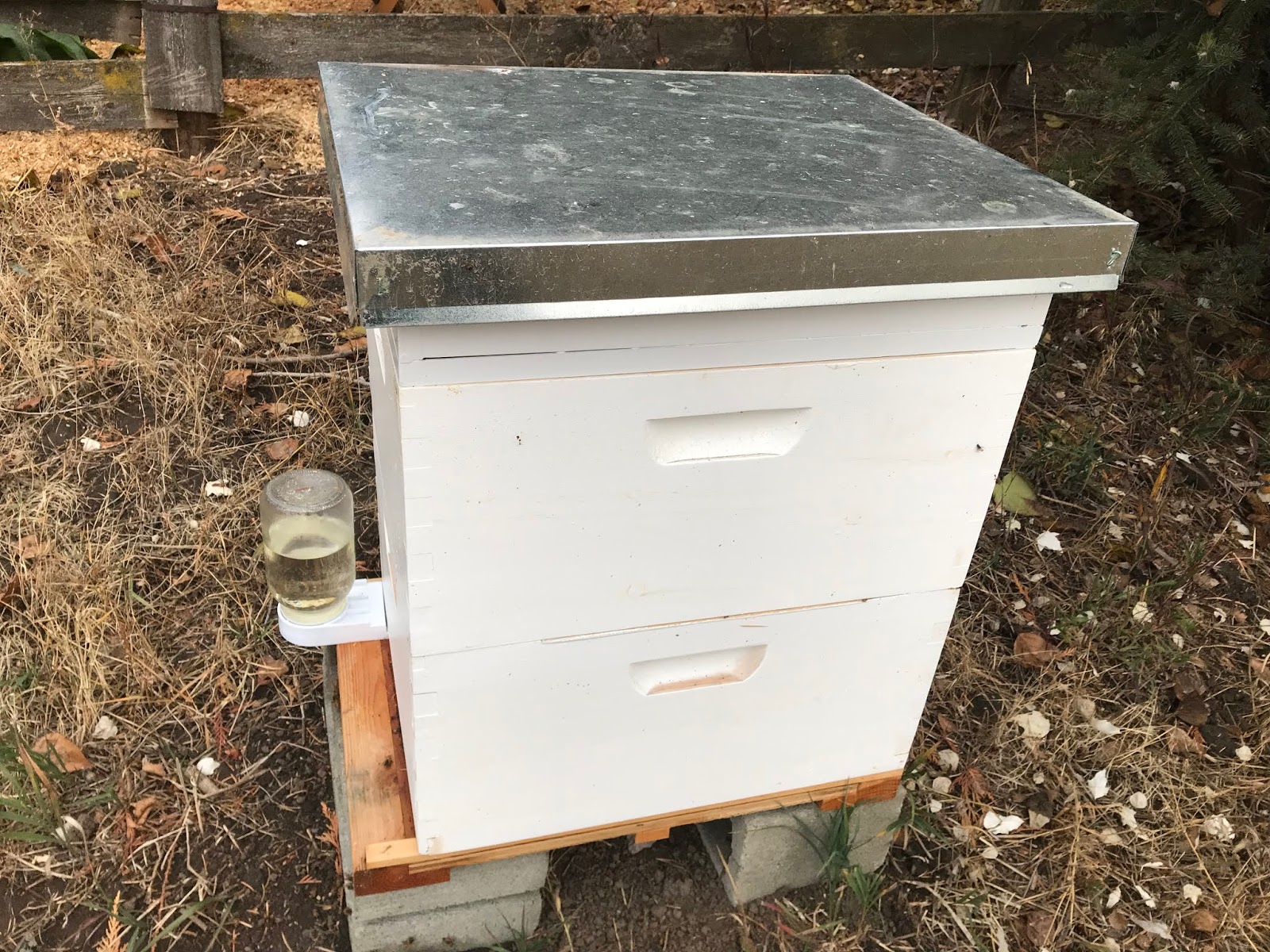
When temperatures warm into the 40's and 50's, the bees will slowly move the cluster around to get to the honey to eat and keep up their energies.  That is why it's so important for there to be a good supply of honey in the hive for the winter.  I have been feeding my bees sugar water since the end of August to make sure they have enough honey in the hive for the winter.

This is my third year of having the top bar hive.  The first year, my bees did not make it through the winter.  This past year they made it!  The hive just exploded with new bees in the spring and then swarmed because it was too crowded for everyone.  I caught one of the swarms and put it into a langstroth hive. 

I have never done anything to overwinter my top bar hive in the past.  This year I heard that you can put some insulation in the top.  So, I grabbed some old burlap sacks out of the barn and cleaned them up and layered them on top of the bars in the hive...
 Then, I closed the lid.  That was easy!

For the langstroth hive I added a quilt box to the top of the hive.   First I took the inner cover and top off of the hive.  Last time I looked in this hive the bees were in this middle section that you can see in the picture.  You cannot tell it but I also added some follower boards on either side of the bees to make the space smaller so it is easier for them to heat it up in there.
 Then, I added the quilt box.  It has a screened bottom.
 On top of the screen, I added some wood shavings.  This is to help in moderating the temperature and absorbing any condensation that may occur.
 Then, I replaced the inner cover...
 ...and put the lid back on the hive.

Now, we cross our fingers and hope for the best.  I really have no idea if either hive will make it through the winter...time will tell! 

~Denise

Sunday, October 21, 2018

Growing mushrooms

In the Garden

I have been wanting to start a mushroom patch in our garden for a while.  I had heard about growing King Stropharia mushrooms in a podcast a while back.  They are also sometimes called wine cap mushrooms.  They are easy to grow and are prolific.  I ordered my spawn (that is what you use to inoculate your patch - it is like seed) in June.  I had a special place under some trees that stayed pretty shaded that I used to place the spawn.  You put the spawn out in wood chips and water, water, water.  

It is important to keep it all moist for the first couple of weeks.  The suggestion that came with my spawn was to water 15 minutes every morning and evening for the first 2 weeks.  Of course, we did not get much rain this summer so I continued to water on a regular basis.  

At the end of July, I started to wander if all my watering was even paying off.  It's not like a plant that you can see growing above ground.  So, I pulled back some of the top wood chips and saw the mycelium...it is hard to see in this picture but the mycelium is the whitish threadlike/stringy stuff...

 Now, I knew that my spawn had spread and was alive.  I kept watering and waited some more and then one day in August I saw baby mushrooms starting to come up...

Then, the mushrooms got bigger.

More mushrooms grew!  They were almost all in the middle of the patch.  I think this area got the most water from the sprinkler that I had on them so maybe that is why they grew best in the middle.
I didn't actually pick any of this first batch.  It was fun to see them grow.  They grow rapidly once they get started.  A couple of weeks ago (it is October now), three more grew along the edge of the patch.  

I am going to put some new chips on top of the patch soon.  Then, next June, I am going to take some of the chips and use it to inoculate a different area.  The directions that came with the spawn said to put it in a shady spot.  I have also read they they can tolerate partial sun so maybe I will get more mushrooms in a sunnier location.  Also, I am curious if we would get a lot of mushrooms in the spring because that is when you usually see a lot of mushrooms growing in this area with the spring rains.  It has been an unusual fall...we have not had much rainfall at all.  It has been hard to know if I should keep watering my food forest and herb garden.  Today, the temps got up into the 70's...that's unusual for this time of year.  I watered my lettuce, spinach and overwintering onions.  Don't misunderstand, I am not complaining about the temps!  I worked on my compost bins today and still have a LOT of cleaning up in the garden area to get done!

Here is a nice collection of blog posts all about King Straphoria mushrooms.  

A fun fact for you taken from Wikipedia:  In Paul Stamets' book Mycelium Running, a study done by Christiane Pischl showed that the king stropharia makes an excellent garden companion to corn. The fungus also has a European history of being grown with corn.  Maybe I should try inoculating my corn patch next year...

~ Denise


Sunday, October 7, 2018

Food Forest

Food Forest

I started a food forest along the fence back behind the garden.  A food garden/forest as defined by Wikipedia is: a low-maintenance sustainable plant-based food production and agroforestry system based on woodland ecosystems, incorporating fruit and nut trees, shrubs, herbs, vines and perennial vegetables which have yields directly useful to humans. 

There are 7 layers to a food forest and even more if you start to count mycorrhiza (fungal/plant) interactions.

I will be the first to admit that I do not have all 7 layers in my food forest.  I do not have vines or root crops (actually, I forgot that root crops should be a part of a food forest)! 

Here is a picture of the food forest in May.  Everything was so small and I thought it would never fill in but things did grow nicely as you can see in the video below.

The plants in a food forest are chosen to benefit each other.  Some are nitrogen fixers, some are dynamic accumulators (pull up nutrients from deep in the soil and bring them up to the surface), some are to attract pollinators, some are to detour pests, some provide shade and some provide food!

Here is a quick walk through of my food forest:

Here is a nice article about forest gardening.  It would be fun to have a food forest around the perimeter of our property but that would take a LOT of work but could be a goal for the future...I like the idea of mixing beneficial plants together and I have SO many more trees I want to add to the property.

The past couple of weeks I have been putting wood chips down on the food forest.
~Denise


Sunday, September 23, 2018

Summer recap 2018 and garden lessons learned...

In the Garden

Our first big garden and there were lots of lessons learned:

The wind can do more damage than the cold/hot temperatures.  
I didn't realize how damaging the wind can be.  In the spring, I was so concerned about cold temperatures and the possibility of a freeze wiping out plants that I had planted early.  BUT the wind can do more damage with knocking plants over that do not have a well established roots system.  Also, the wind can dry things out quickly which can be damaging to the plants.

Seedlings this past spring waiting to go out and be planted in the garden.
Water, water, water is so important.
In north Idaho, you HAVE to have a plan for watering.  The past 3 months, we have had 1 rain of about 1/3 inch.  In August, we had a few days where it got up to 100 degrees.  I implemented some drip hoses and I will need to buy more for next year.  This was a bit of an investment but it will pay off in the long run.  I need to figure out a better system for watering the raised bed stock tanks.  I have an idea already...

Over plant and then thin...seed is cheap but losing 2 weeks of growing weather is expensive.
I was a bit stingy with the seed when planting.  Then, the slugs came in and ate most of the small seedlings.  So, next year, I will plant more and then thin out (or let the slugs thin it out).  The growing season is so short here that you don't want to have to start over.  I am also going to start looking for and buying the shortest season plant seeds I can find.

Slugs are the worst! 
For such a dry climate, I could not believe how many slugs I had eating my sunflowers and lettuces and anything else they could get to (this was mostly in the spring)!  I am going to have to be more proactive about the slugs next year. 

Here is a pic of the celery that I am blanching (that is why I have the paper bags around them).  I harvested them yesterday and cut up put in the dehydrator.  What you can't see is that I had to throw away over half of the celery due to slug damage.  I still got a lot of celery but will set things up differently next year...

I will need to grow a LOT more if I want to preserve things!
We did fine with providing vegetables all summer for our family.  We had fresh spinach, lettuce, beets, green beans, broccoli, cabbage, cauliflower, celery, summer squash, tomatoes, eggplant, potatoes, onions, garlic, corn and peas during the growing season.  This was our first attempt at having a large garden and I was a bit limited on the planting space since I was mostly using the hay bale gardening.  I think once we have the raised beds up and going, we will have a lot more space to plant in them.  Henry built a couple raised beds already and I am just shocked at how much growing space there is (compared to the top of a hay bale).  I did get to dehydrate a few things and I will can some salsa and freeze some corn and green beans.
Veggies growing in the top of hay bales.
Sunflower recap
The peach and white sunflowers just did not work.  The bugs just LOVED the peach sunflowers.  I may actually keep planting them strictly to use as a trap crop for the bugs.  As I mentioned previously, I had trouble with slugs eating the seedling.   I made the rows WAY too close together and I have already taken steps to expand the sunflower growing area for next year.  The voles still got in and got a few of the sunflowers but overall the sunflowers did well! 
Vole damage on end of sunflower stalk.
Birds, Bats, and Bees...
It appears that something is using one of the bee blocks I made!  Nothing is in the other bee block.  I will move it to a better location.
I know several of the bird houses that I made were used.  I have not seen any bats.  I think we are going to move the bat house too.

We made some time for fun at Silverwood.  Mark did not want to get out of the wave pool for like 2 hours!
Joshua, Henry, and Mark in the wave pool at Silverwood.
~Denise

Sunday, September 9, 2018

Now that's an Idaho potato...

In the Garden

I decided to harvest my potatoes yesterday.  The potatoes were grown in the hay bales and we have been stealing some out of the bales as we needed them the past couple of months.  Last time I went in to take some, it seemed to me that some of them were starting to sprout.  So, even though the tops had not died back, I decided to harvest the potatoes.  I was pleasantly surprised!

Potato that is way bigger than my hand.
The good thing about the hay bale garden harvesting is how easy it was to do.  I just had to peel back pieces of the hay bale and grab the potatoes out.  No digging.  No accidentally stabbing potatoes with a fork.  No cutting them in half with a shovel. 
 
Potatoes growing in the hay bale.
 I had planted 3 bales and harvested a 5 gallon bucket of potatoes!  This doesn't count all the potatoes that we had eaten before I went in to "officially" harvest.


Another reason that I wanted to start harvesting them is because we are starting to make some raised beds and I needed a place to put them.  Henry made the frame and I put hardware cloth on the bottom.  It is a little hard to see but the bunch of plants at the end of the bed is the last of the potatoes.  As I harvested them out, I just threw the half rotted hay into the bottom of the new raised bed.


As I had noted in my garden post about a month ago, I almost gave up on even growing the potatoes in the bales.  It took me 3 tries to get them going.  I am SO glad I didn't give up on this!  I also have a 100 gallon potato bag.  I harvested that too.  I didn't even get enough potatoes to fill the bottom of the 5 gallon bucket.  From now on, it will be hay/straw bale potatoes for us!!!

Another note...I planted white and red potatoes.  I got maybe a total of 5 red potatoes.  For some reason, they just did not grow as well.  Maybe I planted more red potatoes in my first 2 failed attempts.  I really can't remember.  I will definitely be saving some of these white potatoes for planting next spring.  I also want to try some other varieties next year.  

Now, I am curing the potatoes and then I will store them.  Here is a great article on storing potatoes.

Next project, besides continuing with building the raised beds, is planting these overwintering onions that I started indoors last month...

~Denise

Sunday, August 26, 2018

Video of herb/pollinator garden

In the Garden

Right outside my kitchen, I have planted an herb/pollinator garden.  I have my bee waterer located in here.  I took a quick video of the herb garden this morning...


I like how the herb garden is coming along.  I still have lots of room to plant more.  I am still working on getting shavings down over the hay and I will also put wood chips down on top of that.  I am going to try and dehydrate some more of the herbs this fall.  I have been able to dry some basil, oregano, parsley, sage, feverfew, chamomile, calendula, mint, and catnip thus far.  I want to look up some recipes for herbal teas to make this winter and use the herbs for these teas (and for cooking too).  Now that we are finished with the Farmer's Market for this year and the boys are going back to school, I should have time to focus on the drying.

Another thing that got put on the back burner was the compost piles/bins.  Finally this past week I was able to get in there and turn all of them.  I have 3 big open piles made out of pallets (actually, it is really 4 piles because I ran out of room and had to just dump some grass beside the pallets) and 3 covered bins up close to the house.  The more open piles had gotten pretty dried out and you need moisture for the microbes to do their job.  The great thing about compost is that you can just leave it and it will eventually work down but it goes faster if you can get in there and turn it.  I was able to harvest out 2 garbage cans full of compost!  In addition, I put a good 5 inches of compost in the blueberry raised beds and covered that with shavings.  That should really give the blueberries a boost.

Harvested compost in garbage can.

~Denise